Query Update and the Wait

© Copyright 2012 CorbisCorporationI’ve been busy with work, taking care of my 83-year-old mother (who recently had some setbacks, but is doing better), and moving. Not much time to devote to writing or querying, but I’m squeezing in some queries to agents here and there.

I’ve been sending queries for my middle-grade novel The Castle Blues Quake and for my young adult historical novel Yakimali’s Gift.

It takes time to first of all find the agents who represent my genre of stories, and then to tailor the query letter to each agent according to their interests. Some agents are looking for stories in both of my genres, so I query one and once I hear back (either positive or negative), I’ll query the other story.

How do I find the agents? I read the Publishers Marketplace Deals, which I subscribe to and receive daily in my email inbox. I look for books that are similar to my genres, and I’ve found many agents (and occasionally publishers) to query this way. You have to do a little legwork to find their contact information (yes, Google is your friend). I also subscribe to Chuck Sambuchino’s Guide to Literary Agents blog/newsletter, which is emailed to me once each week. He always includes new agents who are looking for clients, what their interests are, how to contact them, etc. And then, I might find agents from Twitter followers, other writer friends, books I’m reading. Keep your eye out, because you never know…he or she might just be “the” agent.

And now the wait begins. Some agents say they only respond if they’re interested. I understand they get swamped with queries. Still, it’s a little frustrating not knowing if they’re still considering it or not. But as they say, “Hope springs eternal.”

How do you find agents and/or publishers to query?

Posted in Uncategorized | Tagged , , , , , , , , , | 2 Comments

Road to Publication: An Incurable Bibliomania

Some of my cherished "antiquated" books.

Some of my cherished “antiquated” books.

Do you ever start a book and know right away that you don’t want it to end?

I felt that way recently when I began reading The Bookman’s Tale: A Novel of Obsession by Charlie Lovett. It’s quite a dichotomy when the book is a page turner yet you hate seeing those last pages approaching.

The Bookman’s Tale, though, doesn’t start out as a page turner. Lovett didn’t follow “the big bang” theory when he wrote his first pages. Rather, he eases into what becomes a mystery that takes place in four different time periods.

But this is also a story for book lovers. And I mean lovers of print books. Books with beautiful bindings, flourishes, and dark type set against pages of cream or white that are lovingly turned by hand.

The main character of The Bookman’s Tale is an antiquarian bookseller, and as a college student he finds his passion for books when he stumbles into a job at the university library’s Special Collections department. There he learns to repair books—sometimes hundreds of years old. I found the passages describing the repairs fascinating. In the parts of the story that take place in earlier centuries, Lovett describes the actual making of a book.

These passages, the mystery the main character tries to solve, and the different time periods make this a story to savor.

The Bookman’s Tale also reminds me why I love “real” books as much as I do. Hey, I have nothing against eBooks, but as the author says of himself in his dedication, I have an “incurable bibliomania.”

With eBooks becoming so prominent, how do you feel about print books?

Posted in Uncategorized | Tagged , , , , , | 4 Comments

Interview with Author Terry Reid

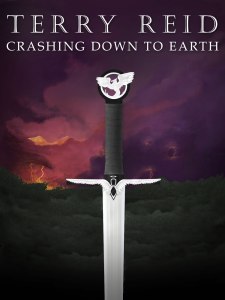
crashingdowntoearth

Today I’m pleased to feature another author interview, this time with Terry Reid, a fantasy and science fiction writer. She was born in England but raised—and is now living—in Scotland. Her latest book, Crashing Down to Earth, is set in Glasgow and tells the tale of Hayley Foster, a student who shares her flat with her guardian angel, Alex. Alex tries to keep his identity a secret but his dark past catches up with him and puts the angel, and Hayley, in danger.

Terry’s Writing Process

Linda Covella: Welcome, Terry! How long have you been a writer?

Terry Reid: Professionally, only for about eight months. But I have been writing for many years.

LC: Do you write in one particular genre, or explore a variety of stories?

TR: I write a mish-mash of fantasy, paranormal and comedy. Some other genres just bore me.

LC: From where do you get your inspiration for your stories?

TR: Quite a few places. Sometimes it just comes to me, other times I could be listening to some really good music, or I could be watching a film.

LC: Does living in Scotland influence your writing?

TR: Yes, I do feel living here influences my work. I use a lot of the cities in my writing, as well as some more rural parts of the country.

LC: What is your writing process? How much/often do you write?

TR: I write pretty much every day, though sometimes I take a break, especially when the creative spark is not there. Like everything else in life, you need to have a rest sometimes.

If the creative spark has gone out, I usually just wait for it to reignite. I find forcing myself to write is a waste of time. I end up with better results when I’m in the mood for writing.

LC: Do you have writing partners who critique your work before submission? Why do or why don’t you think this is important?

TR: I have a few people who critique my work before submission. One of my friends is among them, but he’s brutally honest if something doesn’t work and suggests how to change it so it does.

I think it is important to have a second opinion on your writing. Just because you think something is a good idea doesn’t necessarily mean it is. It’s very easy to become wrapped up in an idea for a story, or a character, or a portrayal, and not realize that it doesn’t work.

Terry’s Road to Publication:

LC: How long have you actively been pursuing publication?

TR: About eight months.

LC: Do you have an agent?

TR: I don’t have an agent, but I’d never rule one out in the future. There might come a time when I’ll need one. I’m not currently looking for one though.

LC: In your view, what are the pros and cons of self-publishing vs. traditional publishing?

TR: All three of the books I’ve published to date are self-published. My next one, Crashing Down to Earth, will also be self-published.

I self-publish because it gives me more creative control of my work. I’ve heard a lot of stories about authors who have had to change their work to make it more appealing to wider audiences, at the request of the publisher for one reason or another.

However, one drawback of this route [self-publishing] is quality control. I’ve read a few self-published books which had great stories but contained poor editing. However, if you can find a good editor and use good beta readers, then there is no reason why you can’t self-publish.

One of the pros of traditional publishers, though, is that they sort out your ISBN numbers. If you’re self-published and don’t live inside the US, you usually have to pay for these yourself, which can be expensive.

LC: What’s up next for Author Terry Reid?

TR: I’m currently writing Crashing Down to Earth (Part Two).

LC: Anything you’d like to add or that we should know about you?

TR: I’d just like to thank you for allowing me the time to visit your blog, and to your readers for taking the time to read my prattles. It has been fun.

LC: It was fun learning more about you, Terry. Good luck and happy writing!

Visit Terry on Facebook at https://www.facebook.com/AuthorTerryReid and at her website  http://fourcornersofsanterria.blogspot.co.uk/

Posted in Uncategorized | 2 Comments

Starting Your Story with a Bang?

Image

It seems that more and more publishers and readers like stories to start off with Action! Excitement! Thrills!

I’m thinking about this because I’m in the middle of reading To Kill a Mockingbird by Harper Lee, and it certainly begins–by today’s standards–slowly. I think the first line pulls the reader in: When he was nearly thirteen, my brother Jem got his arm badly broken at the elbow.

You want to find out what happened, right? After a couple of paragraphs in, though, it might lose some readers as the narrator (Jem’s younger sister Scout) discusses her family’s history and how they came to the town she, Jem and their father, Atticus, now live. A friend of mine said she tried reading the book a few times, but couldn’t get into it. That might just be personal taste, but I hate to see people missing out on this incredible book because they can’t get past the first few pages.

I decided to reread it after a senior citizen friend of mine raved about it. Now, the fact that this particular friend read, finished, and loved To Kill a Mockingbird is a proud moment for me. She is 83 years old and Chinese-American. I’ve been visiting her once a week for the past—has it been 10 years!—to help her with her English. Her exclamations of, “It’s about family! It’s about life! It’s about everything!” had me close to tears. Now I know how teachers feel when a student finally “gets it.”

I read the book many years ago in grade school (isn’t it required reading for all kids?). Between the book and the movie, the story is ingrained in my mind. Lee’s beautiful writing evokes a time period and a place that comes alive through the distinctive voice of Scout—telling the story as an adult but through her perspective as a child.

Published in 1960, To Kill a Mockingbird is still worth reading. And it makes me happy that a book doesn’t have to start with a bang to be a page turner, to be timeless, to be a story “about family, about life, about everything.”

What draws you into a story and makes you want to keep reading?

Posted in Uncategorized | 4 Comments

Image

I love hearing about other authors’ writing journeys, and today I’m pleased to interview author Silvia Villalobos. We met several years ago in an online writing class and have stayed connected ever since, encouraging, commiserating, and celebrating different steps in our writing careers.

Silvia was born in Bucharest, Romania and moved to California in 1992 to finish her studies. She loves to write, read, and hang out with her husband and son at the beach. Her stories have appeared in Fiction365, a Literary Journal, and Red Fez, a Literary Magazine. She is currently working on her mystery novel, Stranger or Friend. 

Silvia’s Writing Process

Linda Covella: Silvia, how long have you been a writer?

Silvia Villalobos: I’ve been actively writing for the past ten years or so, but I remember making up stories in my head–occasionally transferring them onto paper–since I was in grade school.

LC: Interesting…I know many writers who had the “bug” at a young age, but didn’t think of writing as a profession until later in life.

Do you write in one particular genre, or explore a variety of stories?

SV: I write novels and short stories. My novels are always mysteries–those are the story ideas that pop into my head the most. Short stories are about everything, most often life experiences.

LC: Your short stories that I’ve read have a real ring of truth to them. From where do you get your inspiration for your stories?

SV: For short stories, from all around me: friends, family, acquaintances, conversations I overhear, newspaper articles. Anything goes.

For mysteries, it all starts with the premise. That is what I find engaging. The reader is presented with a series of problems and questions which arouse feelings that are often beyond imagination yet seem real. If I do my job right–involve the reader in my fictional world–he’ll hopefully stay with me until the last question is answered, until there is a resolution.

LC: What is your writing process? How much/often do you write?

SV: I usually start with two elements: setting and character. I give the character goals, motivations and conflicts (internal and external). The external conflict is particularly complicated by the world she lives in, hence setting is important.

I write all the time. Even when I don’t actually write (at the computer or on paper), I write in my head by working out scenarios, going over a scene, deciding on a piece of dialog, a description. If I’m visiting a museum, for example, and an idea sparks, I focus on that notion and keep it hidden in the back of my mind, hoping it will resurface at the right time, when I’m writing the right scene. Often it does.

LC: Do you have writing partners who critique your work before submission? Why do or why don’t you think this is important?

SV: I have a handful of writing friends I absolutely cherish. I usually email them a short story, a chapter, even a novel manuscript, and I ask for their opinion. They read my work, and I read theirs. I also submit chapters and short stories to my online critique group, The Internet Writing Workshop (one of the best decisions I’ve made was joining this group), and always receive valuable feedback.

Having my work critiqued in the early stages is important. It helps me see the story in the way a reader might see it. It helps me make it better.

Silvia’s Road to Publication

LC: How long have you actively been pursuing publication?

SV: I submitted three chapters to an agent a couple of years ago–looking back, I wasn’t ready for an agent–and received some advice, but no offer. So, I set out to write for a while and not worry about agents or publication. Just read, write and have fun. To be good, writing has to be fun. At the same time, I worked on my short stories and had a few published.

LC: Do you think an agent would be helpful to your writing career/do you plan to seek an agent?

SV: I don’t have an agent, but yes, I plan to seek one. Working with someone who understands the industry, and understands the constant changes in the publishing world, who can help me appreciate the fine details (the writing is up to me, but like with everything else, there is the business part), can’t be anything but beneficial, in my mind. Of course, signing up with an agent is easier said than done, but I will try.

LC: What’s your take on self-published vs. traditionally published books?

SV: Self-publishing is not for me, not yet anyway, for two reasons. First, I’m not in any hurry. Second, I want to write for an audience, and as I said above, that involves understanding the business, and understanding it very well. My friends and family will buy my books, but will I be able to reach a wider audience as a self-published writer? I’m not so sure.

I’ve done my research on promotion and such, and I don’t feel this is something I can undertake at this point. I’m happy to do my part, as writers are responsible for a big chunk of marketing these days. For the business itself to be remotely successful, I think there needs to be a partnership of sorts in place. Self-publishing is never completely off the table, and I am grateful that I have that choice.

LC: What’s up next for Author Silvia Villalobos?

SV: I have a short story (flash fiction) coming up in July from Pure Slush. I had my mystery novel, Stranger or Friend, evaluated by an editor and am working on her comments. Once that’s done–hopefully this summer–my plan is to take a look at the market and see what my next step is. In the meantime, I write every chance I get. Life is but a series of stories waiting to be told.

LC: Congratulations on your next publication. I’ll look forward to reading it! Also congrats on getting feedback from the editor. That’s a success in and of itself.

Thank you for telling us about your “road to publication,” Silvia. And I think the perfect ending to our interview is a repeat of your lovely last line:

“Life is but a series of stories waiting to be told.”

Posted on by lindacovella | 19 Comments

The Benefits of Starting or Joining a Critique Group

Image

Writing partners can give you invaluable feedback and help bring your writing to the next level—and beyond!

Becoming part of a critique group is one of the best things I’ve done for my writing.

Before that, I was writing in a vacuum, getting only occasional feedback from classmates and teachers. When I became virtual friends with one of those classmates, Mary Beth, she asked me for probably one year to form a critique group with her. It took me that long to get up the nerve to do it.

Don’t Let Fear Stop You

I was afraid of exposing myself and putting myself up for criticism.

Take it from the voice of experience (me!): don’t let fear stop you from sharing your stories with critique partners. Their feedback will be invaluable. Unlike the feedback you might get from friends and family, in a critique group, you’ll receive unbiased advice from fellow writers who know the craft.

Choosing Writing Partners

Whether you’re forming a critique group or looking to join an existing one, there are different places where you can find writing partners. Check with your writer friends, with local writers groups, with writers organizations. Put out an announcement on your Facebook page or Twitter account.

When Mary Beth and I formed our online critique group, we wanted fellow children’s writers as partners, so we put out a call on the Society of Children’s Book Writers and Illustrators (SCBWI) chat forum.

We then interviewed (via email) the respondents, and read samples of their work. We wanted to limit the group to six and soon found our partners. We’ve been together now for almost ten years!

We were lucky, but it can be tough to find a good fit, and you might have to try more than one group before settling in with like-minded writers. When we started our group, we were all newbies, and we helped each other learn the craft, the ins and outs of publishing, how to submit to agents and editors. We encouraged each other when our spirits dove after a rejection—or a devastating personal matter.

You might end up in a group where the writers have different levels of experience, and that can work as well.

Critique Group Guidelines

Following are some guidelines Mary Beth and I wrote for our group that might be helpful if you’re forming your own critique group.

Another good source of information is The Writing & Critique Group Survival Guide by Becky Levine and published by Writers Digest Books.

Critique Group Guidelines:

*Decide how many people you want in your group. We thought six was a good number.

*Decide how you’ll submit your manuscripts. If online, will it be via email (attachment as Word doc or copied and pasted), Yahoo group, or another method?

*Limit the number of words for each submission. We limit ours to 2500 words, which might average 1-2 chapters.

*Submit your best effort. Before submitting, check for spelling, grammar, etc. Allow revisions of previously critiqued submissions.

*Decide on a sequence for submissions. We do the following:

For members A, B, C, D, E and F:

Monday Week 1: A & B submit manuscripts and members prepare critiques of both.

Monday Week 2: C & D submit manuscripts and members prepare critiques of both.

                                Members turn in A & B critiques.  A & B review and can ask questions.

Monday Week 3: E & F submit manuscripts and members prepare critiques of both.

                                  Members turn in C & D critiques.  C & D review and can ask questions.

Monday Week 4: A & B submit manuscripts and members prepare critiques of both.

                                  Members turn in E & F critiques.  E & F review and can ask questions.

Cycle continues.

*If a member can’t submit on their day, let other members know.  Someone else may take that slot.

*When new members are added to the group, consider having a trial period of one critique cycle, which can benefit the new member as well as existing members. When the cycle is complete, all members can answer a questionnaire to determine their satisfaction with the critique group’s process. The questionnaire can also be circulated periodically to identify problem areas, possible solutions, future direction of the group, or to modify a procedure that doesn’t work for all members. In other words, keep communication open!

*When critiquing:

•Constructive criticism is the key.

•Comment on the overall picture (plot, characters, dialogue)

•Include strengths and weaknesses of the story.

•Include specific comments (such as basic editing, point of view errors, deadwood) and give your reasoning for any changes you suggest.

•Comments can be added within the text and/or before or after the text.

•If comments are added within the text, identify them with some distinguishing means (CAPS, brackets, different font). For this, we use brackets for deletions, and CAPS for additions. For Word docs, “track changes” works well.

Do you belong to a critique group? How did you join or form it, and how is it working for you?

Posted in Uncategorized | Tagged , , , , , , , , , , , | 4 Comments

Why I Love to Write for Children

Image

I’ve been to three graduations this summer: one nephew finished up high school and another nephew and a goddaughter graduated from college. Each graduate is off on an entirely different adventure. My younger nephew enters the world of college in the fall and will study engineering. The other two will start sending out resumes in search of that perfect job—one as a sports journalist and one with a career in marketing.

Seeing their excitement and eagerness to move into the next stage of their lives is so inspiring, and reminds me again why I love to write for kids and teens. Their outlook on life is always unique. They approach things with a freshness that we tend to lose as we grow older and get stuck in our routines.

Though I don’t have children, I have plenty of nieces, nephews and godchildren, and they constantly amaze me with their interests and abilities and ambitions. This group of “kids” is aged 2 years (the new generation is here!) to 32, and I’ve watched them grow up, most from birth.

The youngsters are always fun to watch as they show their amazement and delight with each new discovery—discoveries that we have long since taken for granted.

I especially love the 5-8 year olds, the age when I can communicate with them and share with them and teach them. Last summer my husband and I took one of our goddaughters, her husband and their five year old on a camping trip—the little boy’s first. He had a blast, and it was a treat to be a part of his experience.

During the middle-school years, kids are starting to come into their own, learning who they are, and flexing their maturity muscles. Their independence is beginning to flourish as they start to question things and form their own ideas and opinions. And I absolutely love hearing what’s on a kid’s mind–at any age.

I have a great respect for teens. By that age, they’ve developed own one-of-a-kind personalities and strong viewpoints on all sorts of topics. They begin to test and stretch the limits that are attempting to rein them in. Believe it or not, I can still remember those feelings from my own teen years, and it’s an exhilarating time of life.

I think writing for kids keeps me in touch with the feelings from my childhood. It also encourages me to keep an open mind when I’m with kids, to remind me they are unique individuals, and to give them that respect. Finally, in my writing, I hope to entertain, but also to bring to kids the feelings books gave me when I was young, the worlds they opened, the things they taught, the feelings they expressed.

Who is your target audience, and why do you write for them?

Posted in Uncategorized | Tagged , , , , , , , , | 2 Comments

Words of Inspiration

© Copyright 2012 CorbisCorporationThe past couple of weeks on my Patch.com blog, I’ve been talking about handling rejection, finding truths in criticism, and taking risks. The last two discussions were inspired by quotes I’d come across from Tyler Perry and Laurence Olivier.

So that got me thinking about inspirational quotes, sayings that can help you through the rough times, that push you forward toward your goal. I’ve collected several over the years and keep them handy to read when I’m feeling discouraged or frustrated with my writing. Some were directed to me personally from writing teachers or other writers, some speak to writing and creativity, and some inspire and motivate.

Below, I copied some of those quotes. Do you have any quotes that particularly sing to you?

“The essence of fiction is discovering a truth of the heart.” ~Anastasia Suen, children’s book author

“Anything truly good is going to be partly experimental.” ~Richard Kazarian, interior designer

“Every child is an artist. The problem is how to remain an artist after he grows up.” ~Picasso

“Nothing can stop the man with the right mental attitude from achieving his goal. Nothing on earth can help the man with the wrong attitude.” ~Thomas Jefferson

“Success is going from failure to failure without losing your enthusiasm.” ~Winston Churchill

“A few fly bites cannot stop a spirited horse.” ~Mark Twain

“Every oak tree started out as a couple of nuts who stood their ground.” ~Anonymous


Posted in Uncategorized | 2 Comments

When Life Happens

You know when you’re on a roll, you have things you want to accomplish, a plan is in action and you’re on your way?

Then…life happens.

A few weeks back, my 84-year-old mother had a terrible time with a series of seizures, a couple falls, hospitalization, rehab, back to the hospital, and now back at the rehab facility. We almost lost her, but now, thank God, she’s very slowly on the road to recovery. My greatest hope now is that she’ll recover enough to have a good quality of life for some years ahead. My family and I (and physical and occupational therapists) will be working with her and encouraging her so that this can be the reality.

She lives three hours away from me, so between visits and many phone conversations with doctors, I got my work done, but I pushed my writing and submitting to the back burner—and the burner was off!

I’m coming up for air now, and will try to squeeze in some submissions.

I still have that hope and dream that someday Mom will hold a book in her hands that says “by Linda Covella,” a book that she “just knew” was going to happen, a book that will be dedicated to her, because she really truly is the best mom anyone could hope for.

Posted in Uncategorized | 10 Comments

Self-publishing and Distribution

© Copyright 2010 CorbisCorporationMore and more writers are choosing to self-publish. It’s fairly easy these days to self-publish your book, although you have to either create a cover yourself or have a professional do it for you.

And then there’s the marketing. But self-published writers often note that traditional publishers don’t offer the marketing help they used to, especially if you’re a new and untested author, so no matter how you’re published, marketing is mostly up to you. (Another argument in favor of self-publishing is the royalty rates are higher. But you have to sell enough books to make that mean anything.)

And this brings me to the discussion of distribution. I’ve always felt that this is the key to getting your book into the hands of readers. Social media—Twitter, Facebook, Goodreads, etc.—is important, but without a distributor (IMO), it’s a huge struggle to sell a decent amount of books. This is why I’ve continued seeking a traditional publisher.

But I wonder now what distribution options are available for self-published authors. I did a little bit of research, and found the following:

Some companies that offer self-publishing services (editing, cover design, print and eBook production, etc.) also offer distribution as part of their package. For instance, BookBaby.com distributes your eBook to a long list of online bookstores.

Here’s a good article that discusses ways for self-published authors to distribute print books. (A list of distributors is included in the article.) One thing they suggest is offering your book to local independent bookstores on a consignment basis—you’re paid when the book is sold. To work with most print book distributors—or to go the bookstore consignment route–you’ll have to do a short print run instead of POD (Print On Demand). However, one of the distributors on the list, Ingram, offers POD distribution, and they specifically say they work with self-published authors. Unfortunately, none of the distributor websites I checked out publish their prices, but they say in the article it can be an expensive proposition.

So, distribution does seem to be a big advantage of  traditional publishing vs. self-publishing. But if I ever decide to self-publish, working with a distributor is something I’ll investigate doing.

I’d love to hear your thoughts and experience with self-publishing and distribution.

Posted in Uncategorized | Tagged , , , , , , | 2 Comments